Your First EMDR Session: What to Expect (and what comes next)
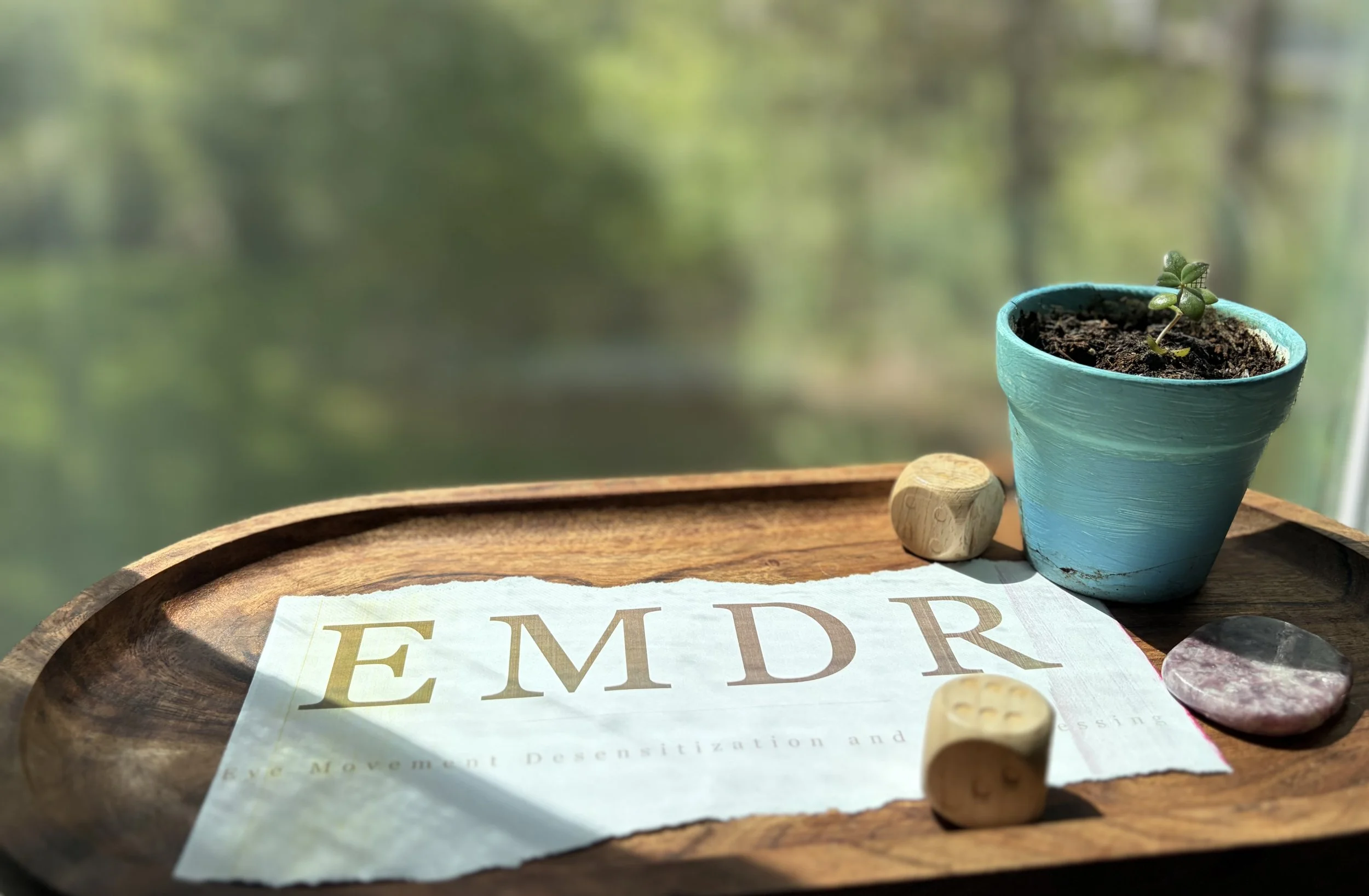
Your first EMDR session isn't what most people expect, and that's usually a relief. If you've done any research, you probably know that EMDR involves processing the past and following something with your eyes. What surprises many people is that your first session probably won't dive straight into trauma. Instead, it focuses on getting to know you, building a sense of safety and trust, and making sure EMDR is the right fit for you. Here's what EMDR looks like in my work with my clients, and what you can realistically expect when you walk in for that first appointment.
What is EMDR?
The part about digging into the past and following something with your eyes? That’s true, but it’s only a piece of the bigger picture.
EMDR is a treatment designed to help heal from painful past expereinces, and reshape how these experiences impact how we view the world, how we show up in relationships, and what we believe about ourselves. These can be experiences that we label as “trauma” or more subtle experiences, like the messages we heard, things we were told, or patterns of mistreatment or neglect over a period of time.
EMDR is an 8-phase model, and the part where you focus on the painful event and move your eyes back and forth (“reprocessing” or “desensitization”) is just one of the phases. There are a few phases before and after reprocessing, and learning just a little bit about the model can help you to feel more comfortable about starting EMDR.
What are the 8 Phases of EMDR?
Phase 1: History and Treatment Planning Phase 1 is all about me getting to know you, understanding what you are hoping will be different once we’ve completed treatment, and coming up with a plan to get you there. During this phase, I’ll ask about your family structure, and we’ll discuss your history, including any difficult or traumatic events, as well as negative messaging and other, more subtle experiences that have shaped your beliefs about yourself. I’ll ask about what symptoms or patterns you are hoping to change, and start to make connections between your history and your symptoms.
Phase 2: Preparation Phase 2 is all about helping you feel safe and ensuring that you feel ready (if still a little nervous) to begin reprocessing. I’ll answer any questions you have, teach you a little more about how EMDR works, and how it can help you specifically, and introduce you to different types of bilateral stimulation, or BLS. I’ll also ask how you cope with stress, and teach some new coping strategies, as well as some tools that will help us as we go through EMDR. In my work, I often blend Phase 1 and Phase 2 together. These two phases will be the focus of the first few sessions.
Phase 3: Assessment Based on the history we took back in Phase 1, we’ll choose a Target Memory for our first reprocessing session. I’ll ask you to watch a movie of this memory in your mind, pausing at the worst part. I’ll ask you to focus on the image that represents that worst part, what emotions are coming up, where you feel it in your body, and what it makes you believe about yourself. I will ask how bad it feels, using a 1-10 scale, and return to this scale periodically throughout reprocessing to help assess how you are moving through the memory.
Phase 4: Desensitization/ Reprocessing This is where we begin “reprocessing” the memory. I’ll ask you to focus on the memory, while you engage in bilateral stimulation, typically following a dot across your screen. I’ll ask you to allow your mind to go where it needs to go, without judging or trying to make sense of it. After each “set” of about 30-45 seconds, I’ll have you pause, take a deep breath, and ask you “What came up?” We keep going with each new piece of information until your SUDS reaches a 0, or in some cases, a 1. I may jump in and offer some insight, or some direction, but in this phase, I am generally there to facilitate your reprocessing, and to stay out of the way, allowing your brain to do the healing work that it’s capable of.
Phase 5: Installation Once we’ve reached a 0-1 SUDS in Phase 4, we will identify a new, positive belief about yourself that’s connected to this memory. We will utilize bilateral stimulation (BLS) to strengthen that belief.
Phase 6: Body Scan Once Phase 5 is complete, I’ll ask you to hold in your mind both the target memory, and the new, positive belief, while scanning your body from head to toe, checking for any lingering disturbance in your body. If anything shows up, we’ll reprocess that before moving on.
Phase 7: Closure Closure is about helping you return to a state of relative calm. I will guide you through deep breathing, guided imagery, movement, or other strategies to help you regulate following a Reprocessing session. I’ll also give you an idea of what to expect or what to monitor in between sessions, and may ask you to engage in some mindful self care before returning to your next task.
Phase 8: Re-evaluation At the start of each new session, I’ll ask you how you felt after the previous session, if anything related to the memory or the belief came up for you between sessions, and how the memory feels now. I’ll ask you if you feel okay returning to reprocessing (either that memory, or, if complete, choosing the next target memory) or if there is something else you’d prefer to focus on that day.
So there it is in a nutshell. Your first EMDR session may not feel a whole lot different from any past experiences you’ve had in therapy. It may be a little more thorough, or a little more focused on the past, but overall, the first session is really just about us getting to know each other, making a plan, and me helping you feel grounded and safe before we move to any actual reprocessing. And when you are ready for reprocessing? We’ll take it at your pace, and only when you say you’re ready.
Will EMDR Feel Emotional?
It might. Even in an early session, simply talking about what's brought you to therapy can feel pretty emotional. That's completely normal, and I’m here to help you move through it at a pace that feels manageable.
I won’t ask you to sit with more than you can handle. A good EMDR therapist pays close attention to your window of tolerance: the zone where you're able to process difficult material without becoming overwhelmed or shutting down. If something starts to feel like too much, you can say so and we’ll slow down. You're always in the driver's seat.
How Long Does EMDR Take?
The honest answer is, that depends. There really is no universal answer, and the length of treatment is dependent on many factors: the nature of your trauma or experience; whether we are treating a specific memory, or a series of memories that occurred over a period of time; what coping skills and tools you already have when you come to therapy; what your current situation looks like in terms of stressors and support. A single incident trauma, such as a car accident, may see relief with EMDR in just a few sessions; however, someone healing from years of developmental or relational trauma will likely take longer.
How Long Is My First EMDR Session?
In my practice, I typically start with a 60- minute intake session. After that, sessions are most often 55 minutes; however, my clients often find that longer sessions work better for EMDR. Extended sessions are typically 90 minutes, but can also be several hours. I work with my clients to find a session length that works best for them.
A Few Things That Might Surprise You
You don't have to share every detail of what happened. EMDR is not a talk therapy in the traditional sense. You don’t have to talk through every memory, or share every detail of what happened. EMDR processes these memories internally, with your therapist supporting you as you and guiding this process.
It might feel anticlimactic. And that's okay. Some people leave their first session feeling a little underwhelmed, like "that's it?" The early phases of EMDR are intentionally gentle. The depth comes later, once you’ve gotten at least a little bit comfortable with the process, and have established some trust with your therapist.
You might feel tired afterward. Even a first session that doesn't involve formal processing can be surprisingly draining. Give yourself some grace after your appointment. I recommend taking some time for yourself after each EMDR session, especially the first few. Plan to take a walk, stretch, journal and reflect on the experience, or just sit quietly for a few minutes.
Every session doesn’t have to be EMDR. Some of my clients have expressed hesitation about starting EMDR because they worry they will miss having space to talk through things that are going on in their life, or that it will feel too heavy to focus on the past week after week. YOU are in charge of how we spend each session. If you choose to do EMDR every session, we’ll do EMDR every session. If you’d like to have a session now and then to talk through something that’s bothering you, that’s what we’ll do.
What If I'm Nervous About Starting EMDR?
Being nervous about starting EMDR (or, for that matter, anything new) is not just okay, it’s pretty standard for most people. Many of the clients I work with arrive at their first session carrying a lot of anticipatory anxiety. They're worried about losing control of their emotions, being overwhelmed, or "doing it wrong."
Here's what I want you to know: you cannot do EMDR wrong. You don't have to perform or prepare or arrive with the right answers. You just have to show up. A huge part of EMDR is just showing up, and trusting the process enough to let your mind go where it needs to go to process the material.
The fact that you’re even thinking about taking this step takes courage. Chances are, you’ve been carrying all of this for a long time, and it can be scary to think not just of going back into some of these uncomfortable or painful memories, but also to think about what it could be like to finally release it all. But remember that the nervous system that's been working so hard to protect you is also capable of healing, and EMDR is one of the most effective tools we have to help that happen.
Ready to Learn More?
If you're curious about whether EMDR might be a good fit for you, I’d love to connect. You can learn more about EMDR and my therapy practice by visiting my EMDR page here. You can also reach out here to schedule a free consultation call.
Susan Candiloro, LCSW-R, is an EMDRIA Certified Therapist and EMDRIA Approved Consultant in Albany, NY. With over 25 years of experience in the mental health field, Susan specializes in working with women navigating shame, anxiety, perfectionism, and late-diagnosed ADHD, providing virtual EMDR therapy across New York and Florida. Interested in working with Susan? Reach out here.